Canadian Housing Market vs. U.S. Housing Market: Why Affordability Challenges Look Different
Housing affordability is one of the biggest economic challenges facing both Canada and the United States in 2025. At first glance, the markets may look similar: rising mortgage costs, strained buyers, and high demand in...


Housing affordability is one of the biggest economic challenges facing both Canada and the United States in 2025. At first glance, the markets may look similar: rising mortgage costs, strained buyers, and high demand in major cities. But beneath the surface, Canada’s housing market faces unique structural issues that make affordability a bigger hurdle than in the U.S.
Mortgage & Interest Rates
The Bank of Canada and the U.S. Federal Reserve have both started to cut interest rates this year, easing some of the pressure on borrowers. In Canada, five-year fixed mortgage rates have dipped below 5 percent at some lenders, while in the U.S., the average 30-year fixed mortgage rate has fallen closer to 6 percent.
Here’s where the difference lies: Canadian borrowers typically face shorter mortgage terms and must requalify every few years, exposing them to rate hikes at renewal. In contrast, U.S. buyers can lock in a 30-year rate, giving them long-term stability even if rates rise later. This structural difference makes Canadian households far more sensitive to interest rate changes.
Housing Supply Constraints in Canada
Another key difference is supply. Canada’s housing market, particularly in Vancouver and Toronto, has been constrained for decades due to zoning restrictions, geographic limitations, and slower development timelines. Population growth, fueled by record immigration, has only added more pressure.
In the U.S., while housing supply is tight in major coastal cities like San Francisco and New York, many regions still have room to build. States such as Texas and Florida continue to add housing stock at a pace that Canada’s largest cities simply cannot match. This makes affordability more flexible in the U.S. compared to the chronic undersupply in Canada.
Price-to-Income Ratios
One of the clearest measures of affordability is the price-to-income ratio. In Vancouver, the ratio remains among the highest in the world, with average home prices more than 11 times the median household income. Toronto follows closely behind.
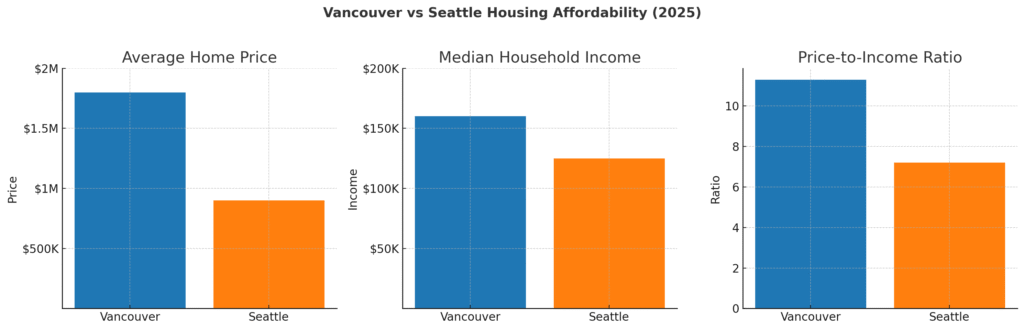
By comparison, U.S. cities like Seattle and Los Angeles have high ratios, but they are generally lower than Canada’s top markets. Even in expensive regions, wage growth and greater housing availability keep ratios from reaching the extremes seen in Canadian markets.
Market Trends Across Canada and the U.S.
Across Canada, affordability challenges are pushing buyers toward secondary markets like Calgary, Edmonton, and Halifax, where price-to-income ratios are far lower and new construction remains more attainable. Vancouver and Toronto continue to face demand, but much of it is being funneled into presale condos and townhomes as buyers seek entry points into the market.
In the U.S., migration patterns are shifting demand from expensive coastal cities to more affordable metros. Phoenix, Austin, and Nashville have seen strong population inflows, supporting price growth even as affordability in legacy markets remains stretched.
Global Real Estate Context
Globally, Canada’s affordability crisis is more comparable to cities like Sydney, Hong Kong, and London, where geographic constraints and population growth collide with limited housing supply. The U.S., by contrast, aligns more closely with European countries such as Germany or Spain, where affordability pressures exist but regional markets can absorb population shifts more easily.
What This Means for Buyers in Both Countries
For Canadian buyers, the path forward remains difficult. Even with lower interest rates, the combination of high prices and strict mortgage stress tests keeps many on the sidelines. This environment makes presale condos attractive, as they allow buyers to enter the market with smaller upfront deposits and delayed completions.
For U.S. buyers, affordability varies widely by region. While San Francisco and New York remain expensive, large swaths of the Midwest and South still offer relatively affordable housing compared to Canadian urban centres. This regional flexibility simply does not exist in Canada, where affordability issues are more widespread.
What to Watch Next Week
Canada’s next housing data release will focus on sales-to-listings ratios in major markets, revealing whether easing rates are unlocking demand. In the U.S., attention will be on housing starts, an important indicator of how much new supply is coming to market. Both countries face affordability hurdles, but the way these markets evolve will continue to highlight just how different Canada’s housing challenges are compared to its southern neighbour.