·
Book a Call

No New Launches, But 26 Projects Completing: The Metro Vancouver Presale Opportunity Most Buyers Are Missing

If you’ve been watching the Metro Vancouver presale market and wondering why nothing new seems to be launching, you’re not imagining it. The first quarter of 2026 recorded zero concrete condo launches across the entire region — compared to 152 in Q1 2025. Developers who can’t hit the presale thresholds required for construction financing are sitting on the sidelines, waiting for conditions to improve before they commit to a new tower.

For buyers, the instinct is often to wait too — to hold off until the market “does something.” But there’s a compelling case to be made that the smartest move right now isn’t waiting for the next launch. It’s looking at what’s already built, or nearly built, and negotiating from a position of real strength.

This year, more than 26 notable projects are reaching completion across Metro Vancouver. That means a meaningful volume of near-completion and move-in-ready presale inventory is entering the market — often held by developers who are highly motivated to close. And in a buyers’ market where condo prices are down nearly 8 per cent year-over-year, that motivation translates directly into negotiating room for buyers who know what to look for.

Why Zero New Launches Is Actually News Worth Paying Attention To

The absence of new launches isn’t just a curiosity — it has real downstream consequences for buyers over the next two to three years. When developers aren’t launching today, the supply pipeline thins out considerably for 2028 and beyond. Metro Vancouver’s population is still growing. Demand for housing isn’t disappearing. What’s happening now is a compression in the pipeline, not a structural end to presale development.

The practical implication: buyers who secure a unit in a completing project today are locking in at today’s softened prices, with a much shorter wait to occupancy than a traditional presale, and with far less uncertainty about whether the project will actually get built — because it already has been.

What’s Completing in 2026

Several significant projects are wrapping up across the region this year. In Burnaby, Concord Pacific’s first phase at Concord Metrotown involves three towers — 65, 45, and 33 storeys — totalling nearly 1,400 condominium homes, all reaching substantial completion this year. Also in Burnaby, Polygon Homes’ 38-storey Perla tower is delivering approximately 330 strata market homes. In Coquitlam, Concert Properties’ 50-storey Myriad tower is working through final inspections.

These are projects from well-established developers with strong track records of delivery in Metro Vancouver. That matters enormously at the due diligence stage — and it’s part of what makes completing inventory so different in risk profile from a new launch where construction hasn’t even begun.

Across the wider region, the Daily Hive has identified 26 notable projects reaching completion in 2026 in Metro Vancouver. That’s a significant volume of inventory entering a market where buyer demand remains soft — which sets up a genuine negotiation window that is unlikely to last once the broader market turns.

The Rate Environment: Fixed Rates Have Risen, But Variable Remains Workable

One piece of context that matters for buyers right now: fixed mortgage rates have climbed due to rising bond yields. Major bank five-year fixed rates are sitting around 4.29 per cent as of late April, with some brokers offering closer to 3.9 per cent. Variable rates through brokers are available around 3.4 to 3.65 per cent, with the Bank of Canada’s overnight rate held at 2.25 per cent on April 29 — and the prime rate at 4.45 per cent.

For buyers considering near-completion presale units, this rate environment is actually more predictable than it would be for a traditional presale with a two-to-three year completion window. You can get a rate hold or firm mortgage pre-approval now because you’re buying something that will complete within months, not years. That clarity removes one of the major uncertainties that hangs over conventional presale purchases in a volatile rate environment.

What the Price Correction Means in Practice

Metro Vancouver condo prices are currently sitting approximately 7.9 per cent below where they were a year ago, with the benchmark condo price in the region around $708,000 — down roughly 6.8 per cent year-over-year. BC home sales more broadly came in at 6,315 transactions in April, down 1.9 per cent compared to April 2025.

For buyers, this correction isn’t a reason to panic or stay out — it’s a recalibration to more realistic levels after years of prices that were, by most measures, unsustainable. Buying at today’s prices in a completing project means you’re not paying a 2021 premium. You’re paying a 2026 price with 2026 context, in a building you can walk through before you sign.

What This Means for Buyers Right Now

The window of genuine buyer advantage in Metro Vancouver doesn’t stay open indefinitely. It opens when inventory is high, launches are slow, and developers are motivated — and that’s exactly the conditions in play right now. Here’s how to approach it practically.

First, focus your search on projects that are 90 per cent or more complete, or already at occupancy. These are the situations where developers want to close quickly and will often negotiate on assignment pricing, upgrades, or deposit structures. Second, verify the developer’s financial standing and project completion status independently — your real estate lawyer can help with this. Third, get your financing in order now, before you’re in a negotiation. A buyer who walks in pre-approved moves faster and negotiates harder than one who hasn’t.

The market is offering something it doesn’t offer often: time. Use it to prepare, then act when the right opportunity presents itself.

The Bottom Line

Zero new presale launches sounds like bad news. In reality, for buyers who understand the market, it’s a signal that the window of opportunity in completing and near-completion inventory is wide open. Twenty-six projects wrapping up across Metro Vancouver this year, softened prices, motivated developers, and a stable rate environment for near-term closings — the pieces are in place for buyers who are ready.

If you’d like to know which completing projects in Metro Vancouver are worth a serious look right now, register at vancouverdwelling.ca/market-intel/ and I’ll make sure you hear about the right opportunities first.

— Jacky, Vancouver Dwelling

Sources: Business in Vancouver, Daily Hive Urbanized, Storeys, RBC Royal Bank, BCREA, CREA.

Metro Vancouver Presale Market Report — May 2026

Metro Vancouver’s presale condo market remains at historic lows heading into the final stretch of May 2026, but the picture is more nuanced than the headline numbers suggest. New project launches have effectively stopped, completing inventory is rising, and buyers are operating in conditions that haven’t existed in this city for over a decade. Here is the data as it stands.

Presale Activity and Launches

The first quarter of 2026 recorded zero concrete condo launches across Metro Vancouver — compared to 152 in the same period of 2025. Broader BC presale unit sales came in at just 124 transactions in Q1 2026, against approximately 6,000 in Q1 2021 at the peak of the market. Townhome launches also softened, with 334 project launches in Q1 versus 507 a year prior.

The reason is structural: Canada’s major banks typically require developers to presell approximately 70 per cent of a building’s units before providing construction financing, and that threshold is currently out of reach for most new projects. An estimated 61 per cent of the 16,589 presale units tracked across the region sit below that threshold. Industry groups are lobbying lenders to reduce the requirement to 50 per cent, a level more aligned with federal banking regulator OSFI guidance — but no formal change has been announced.

On the other side of the equation, more than 26 notable projects are reaching completion in Metro Vancouver in 2026, including major deliveries in Burnaby and Coquitlam. This completing inventory represents the most active segment of the presale market right now.

Resale Condo Conditions

The broader resale condo market provides the pricing context for presale decisions. The benchmark condo price in Metro Vancouver sits at approximately $708,000 as of May 2026, down roughly 6.8 per cent year-over-year. Overall Metro Vancouver benchmark home prices came in at $1,098,000 in April 2026, a 6.9 per cent annual decline and a 0.6 per cent decrease from March. Apartment sales fell 10.7 per cent year-over-year in April, while detached home sales rose 14 per cent — a notable divergence within the market.

Active listings across Metro Vancouver remain elevated at approximately 37 per cent above the 10-year seasonal average, and the sales-to-active-listings ratio for apartments is around 14 per cent — below the 20 per cent threshold that generally signals balanced conditions. BC residential sales totalled 6,315 transactions in April, down 1.9 per cent from April 2025.

Financing and Interest Rate Environment

The Bank of Canada held its overnight rate at 2.25 per cent on April 29, 2026, leaving the prime rate at 4.45 per cent. No rate change is widely anticipated before the next decision date of June 10. Variable mortgage rates through brokers are available in the 3.4 to 3.65 per cent range. Five-year fixed rates have risen due to upward pressure on government bond yields; major bank rates sit around 4.29 per cent, with broker rates closer to 3.9 per cent for well-qualified buyers.

Inventory and Absorption

With launches stalled and completing inventory rising, the effective supply picture is shifting. Unsold developer inventory in completing buildings is moving slowly — in some projects, sales have slowed to one or two units per month — creating holding cost pressure that is motivating discounting and negotiation. Reports of bulk unit sales to institutional buyers at 15 to 20 per cent below asking have surfaced across Metro Vancouver.

For individual buyers, this environment translates to genuine negotiating leverage that has been absent from this market for most of the past decade. The BCREA forecasts BC residential sales to fall a further 2.1 per cent to 68,700 units for the full year 2026, with average prices expected to decline approximately 1.4 per cent to $939,800.

Outlook

The near-term trajectory points to continued softness in new launches through at least the second half of 2026. The completing inventory wave currently moving through the market will provide negotiating opportunities for buyers through mid-year before absorption gradually reduces the available stock. Rate stability at current levels supports buyer purchasing power, though upward pressure on fixed rates bears watching heading into Q3.

Stay current at vancouverdwelling.ca/market-intel/

— Jacky, Vancouver Dwelling

Data sources: Business in Vancouver, BCREA, CREA, Daily Hive Urbanized, Storeys, Bank of Canada (April 29 2026 rate decision), RBC Royal Bank.

The $50,000 Reason First-Time Buyers Should Be Looking at Vancouver Presales Right Now

If you’ve been sitting on the sidelines watching the Metro Vancouver presale market, waiting for the right moment to make a move, this might genuinely be it. A new federal law that quietly received Royal Assent in March 2026 could hand first-time buyers up to $50,000 back on a new condo purchase. Stack that on top of the most buyer-friendly presale conditions Vancouver has seen in years, and the picture looks meaningfully different than it did twelve months ago.

Here’s what you need to know.

The New GST Rebate: What It Is and Why It’s a Big Deal

Bill C-4, the Making Life More Affordable for Canadians Act, received Royal Assent on March 12, 2026. Buried inside this legislation is a brand-new GST rebate exclusively for first-time buyers purchasing new or substantially renovated homes, and the numbers are significant.

First-time buyers can now recover 100% of the federal GST on new homes priced up to $1,000,000. The rebate phases out linearly between $1M and $1.5M, reaching zero at the top of that range. In practical terms: buying a new condo at $900,000 means $45,000 back. At $1,000,000, you recover $50,000. That’s not a discount. It’s money back in your pocket on a transaction you were already planning to make.

Presale condos are specifically included. In BC, GST on a new home is the buyer’s responsibility at the time of completion. With this rebate in place, your builder will typically credit the amount back at closing, so you don’t need to chase it yourself. You can also apply directly through CRA My Account or by filing Form GST190 within two years of closing.

The eligibility definition is important to understand. The legislation uses a rolling four-year lookback: if you have not owned and lived in a primary residence anywhere in the world at any point over roughly the past four years, you likely qualify. This is more flexible than many people assume, so it’s worth checking carefully if you’re unsure about your own situation.

Who Qualifies and Who Might Be Surprised to Find They Do

The four-year window is broader than the old first-time buyer definitions many people are used to. If you owned a property years ago but have been renting since, you may qualify. Recent newcomers to Canada who never owned here but owned abroad previously should note that the clock still applies to worldwide ownership, so read the fine print carefully. If you’ve been out of the housing market for a few years for any reason, it’s well worth confirming your eligibility with a real estate lawyer or your lender before assuming you don’t qualify.

What makes this especially relevant to presale buyers is the timing. You sign a presale contract today, your home completes in 2027 or 2028, and the rebate applies at completion, not at signing. That means buyers who are thinking ahead have a window to plan around this.

The Presale Market Right Now: More Buyer-Friendly Than It’s Been in Years

The GST rebate lands in the middle of a presale market that’s already tilted sharply in buyers’ favour. New presale launches across Greater Vancouver and the Fraser Valley have slowed dramatically. Early 2026 saw only 64 new presale homes come to market in a single month, compared to a normal figure above 1,100 units. Developers who are actively selling are competing hard for a smaller pool of qualified buyers.

The result is an incentive environment that industry observers are describing as the most aggressive since 2018. Developers are offering reduced deposits (some as low as 1%), strata fee coverage, cash credits, assignment clauses, interior customization packages, extra parking, and more. The benchmark condo price in Metro Vancouver has also softened, sitting around $708,000 (down roughly 6.8% from a year ago), with active listings well above the ten-year average.

Lower prices, aggressive developer concessions, and a new federal GST rebate on top create a layered value proposition that hasn’t existed in Vancouver for a long time.

Where to Look: Neighbourhoods and Project Types Worth Watching

The current market has a heavier focus on wood-frame and townhome product compared to the high-rise heavy cycles of years past. This actually suits a lot of first-time buyers who want more space, a suburban feel, or transit-adjacent locations outside the downtown core.

Suburbs well-served by existing or upcoming SkyTrain infrastructure remain particularly compelling for presale buyers thinking about long-term value. Areas near Metrotown in Burnaby, transit corridors in Coquitlam, and established nodes in Richmond and North Vancouver continue to offer new development options at price points that are more accessible than Downtown Vancouver, while still hitting the qualifying threshold for the full GST rebate.

Buyers should also pay attention to projects completing in the 2027-2028 window. The presale market is expected to remain soft through much of 2026, with improved conditions projected further out, which means today’s pricing and incentives may look increasingly attractive in hindsight.

What the Rate Environment Means for Your Planning

The Bank of Canada held its overnight rate at 2.25% at its April 29 announcement, with the next decision scheduled for June 10, 2026. Forward-looking guidance suggests the policy rate is likely to remain broadly stable through this year. For presale buyers, that’s useful: variable rate mortgage costs aren’t expected to spike, and the carry cost of a presale assignment or completion financing is more predictable than it was during the rate volatility of 2022-2023.

Fixed mortgage rates remain influenced by bond markets and those can move, but the current rate environment is meaningfully more stable than it was at the height of the tightening cycle. Presale buyers who are locking in today with a 2027 or 2028 completion have reasonable visibility on the financing landscape.

What This Means for Buyers: Practical Takeaways

The combination of factors right now is genuinely unusual. You have a new federal rebate worth up to $50,000 for first-time buyers, a softened price environment, developers competing aggressively for your business, and a stable rate backdrop. None of these factors is permanent.

If you’re a first-time buyer who has been waiting to get into the market, the practical advice is to get clear on your eligibility for the GST rebate first. It should be one of the first conversations you have with your lender or lawyer. Then start exploring which presale projects fit your timeline and location preferences, because developer incentives are time-sensitive and the project selection available right now may not exist in another year.

If you’re an investor or move-up buyer, the picture is different, but even for non-first-time buyers, the current presale environment offers negotiating leverage and project selection that hasn’t been available since the pre-pandemic years.

Ready to Explore Vancouver Presales?

The market moves faster than most people expect when the fundamentals shift. Right now, the fundamentals for first-time presale buyers in Metro Vancouver are about as favourable as they’ve been in a decade. The right project, at the right price, with the right incentives, is out there.

At Vancouver Dwelling, we track every active presale project across Metro Vancouver and give our VIP clients early access before the general public. If you want to see what’s available and understand exactly how the new GST rebate applies to your situation, register for VIP access at vancouverdwelling.ca.

There’s no cost, no obligation, and no pressure. Just the information you need to make a smart decision.

Jacky, Vancouver Dwelling

Disclaimer: This post is for informational purposes only and does not constitute legal or tax advice. Consult a qualified real estate lawyer or tax professional to confirm your eligibility for the GST rebate.

Explore Further: Ready to act on that opportunity? Browse our Downtown Vancouver presale condos to see what’s currently available — and reach out to get on the VIP list before public launch.

Bank of Canada Holds at 2.25% — What Vancouver Presale Buyers Need to Know Right Now

This morning, the Bank of Canada announced it would hold its overnight lending rate at 2.25% — its fourth consecutive pause since last October. For anyone watching the Vancouver presale condo market, this decision lands at a pivotal moment, and it deserves a closer look than the usual “rates unchanged” headlines suggest.

The short version: variable rates are staying put for now, but fixed rates are quietly creeping up due to global pressures, and the presale landscape in Metro Vancouver is leaner than it’s been in over a decade. That combination creates a specific set of conditions that every presale buyer — whether you’re just researching or already registered for a project — needs to understand heading into spring 2026.

Here’s what the data is telling us and what it means for your decision.

Why the Bank of Canada Held — And Why It’s More Complicated Than It Looks

The BoC’s decision to hold at 2.25% wasn’t a confident “all clear” signal. Policymakers are threading a narrow needle: domestic economic data is soft (BC home sales are projected to fall another 2.1% this year), but renewed inflation pressure from the conflict in Iran has sent global oil prices higher, creating upward pressure on the cost of living. With Canada-US trade negotiations also scheduled for this summer, the Bank signalled it’s in a genuine “wait and see” mode.

Crucially, the Bank’s next rate decision isn’t until June 10. Until then, variable mortgage rates will hold roughly where they are — hovering around 3.4% to 3.85% depending on your lender. That’s still historically reasonable, and for presale buyers with completions scheduled later this year or in 2027, it offers some breathing room.

But here’s the nuance that many buyers are missing.

Fixed Rates Are Moving in the Other Direction

While the BoC holds steady, fixed mortgage rates have been quietly rising. Bond yields — which fixed rates track closely — have climbed in response to the same geopolitical pressures the Bank is monitoring. As of today, five-year fixed rates in BC sit around 4.04%, with three-year fixed rates at approximately 4.30%.

That matters for presale buyers because most people who purchase a new development today won’t be securing their mortgage until completion — which could be one, two, or even three years away. You’re not locking in a rate today. You’re making a purchase decision today and hoping the rate environment is favourable when you close.

If fixed rates continue drifting upward before your completion date, your financing costs will be higher than what today’s rate sheets suggest. This is why stress-testing your presale purchase against a range of rate scenarios — not just today’s — is so important.

The Vancouver Presale Market: Historic Quiet Creates Real Opportunity

Beyond rates, the bigger story for presale buyers right now is how dramatically the supply of new presale launches has contracted. In February 2026, just 64 new presale homes came to market across the entire Greater Vancouver and Fraser Valley region. For context, a typical February sees over 1,100 units launch. That’s roughly 6% of historical norms.

The reason is straightforward: developers are cautious. With Metro Vancouver benchmark prices down 6.8% year-over-year (now sitting at $1,104,300), and March 2026 resale volumes running 31.8% below the 10-year average, builders aren’t rushing to launch into soft demand. Many projects have been delayed with no firm timelines, and the developers who are bringing projects to market are increasingly targeting end-users — people who want to live in what they buy — rather than investor purchasers.

The sales-to-active listings ratio across Metro Vancouver is sitting at 14.2%, which firmly places us in buyer’s market territory. Anything below 12% signals a buyer’s market, and we’re not far above that threshold.

What a Thin Presale Market Means for Buyers Who Are Ready

Here’s where the narrative flips in your favour. When the presale market is this quiet, the projects that do launch tend to come with more motivated developers and, increasingly, buyer-friendly terms. We’re seeing more developers offer extended deposit structures, free assignment clauses, capped levies, and enhanced incentive packages — concessions that would have been unthinkable during the 2021–2022 frenzy.

The pool of competing buyers is also smaller. If you were trying to purchase a presale two or three years ago, you were often competing against dozens of registered buyers for a limited allocation. Today, the dynamics have reversed. Developers need qualified, committed buyers, and that gives you negotiating leverage you simply didn’t have before.

For buyers who have pre-approval in hand, a down payment ready, and a clear picture of their completion timeline, this is genuinely one of the better environments in recent memory to purchase a presale — not because prices are at a bottom (no one can promise that), but because the conditions are in your favour as a buyer rather than a seller.

What This Means for Buyers at Different Stages

If you’re still researching: Use this slower period to get thorough. Build out your shortlist of neighbourhoods — areas like North Vancouver, Coquitlam’s Burke Mountain, and Surrey’s Fleetwood corridor continue to see completions this year from major builders including Anthem, Beedie, Polygon, and Concert. Understand your financing capacity at a range of rate scenarios, not just today’s.

If you’re registered for a project launching soon: Pay close attention to the completion timeline and what that means for your rate environment at closing. If fixed rates continue to rise, locking in a rate-hold through a lender early — even before you finalize purchase — can provide valuable insurance.

If you’ve already purchased presale and are awaiting completion: The combination of softening benchmark prices and rising fixed rates is worth discussing with your mortgage broker now. Get clarity on your rate-hold options and what the gap between your contract price and current comparable sales looks like in your specific building and neighbourhood.

The Bigger Picture: Patience Is Being Rewarded

The Vancouver presale market has been through a significant correction. That correction has been uncomfortable for many who bought at the peak, but for buyers entering today, it represents a reset toward more sustainable conditions. Prices are softer, competition is lower, and developers are more flexible than they’ve been in years.

The Bank of Canada’s hold this morning doesn’t change any of that fundamentally. What it does confirm is that we’re not in a rate-cutting environment right now — and that the people who benefit most from the current market are buyers who are well-prepared, not those waiting for a single catalytic moment to trigger action.

Ready to Explore What’s Available?

If you’re considering a Vancouver presale purchase and want VIP access to new project launches before they open to the public, register with Vancouver Dwelling. We work directly with developers across Metro Vancouver to provide early access, floor plan previews, and pricing before public launch — at no cost to buyers.

Have questions about a specific neighbourhood or project? Reach out directly — we’d love to help you navigate the market.

Sources: Bank of Canada (April 29, 2026), BCREA Housing Market Update & Q2 2026 Forecast, Rain City Properties April 2026 Market Snapshot, Daily Hive / Storeys presale launch data, WOWA.ca Vancouver Housing Market, RBC Royal Bank rate update.

Explore Further: With rates on hold, the window to lock in presale pricing is open. Explore presale projects across Metro Vancouver and get in touch for VIP access before public launch.

Vancouver Presale Market Update – April 2026

The Greater Vancouver presale market continues to attract strong interest from both first-time buyers and seasoned investors. Here’s what you need to know this month.

Key Trends This Month

Developers are launching new projects in high-demand areas including Coquitlam, Burnaby, and Surrey. Presale pricing has remained relatively stable, making now a good window for buyers who want to lock in today’s prices before the next uptick.

What This Means for Buyers

If you’re considering a presale purchase, the key advantages right now include flexible deposit structures and the ability to choose your floor plan and finishes. With construction timelines typically running 2–4 years, buyers who act now can benefit from appreciation before they even receive their keys.

Get VIP Access

Want to be the first to hear about new project launches and VIP pricing? Sign up for VIP access and I’ll reach out personally when something matches your criteria.

Jacky Ng PREC* | Vancouver Dwelling | WhatsApp Jacky

Explore Further: Looking for a strong-value play in the current market? Browse our Burnaby presale condos — one of Metro Vancouver’s most active presale markets right now.

BC’s Housing Market Outlook for 2026: What Buyers and Sellers Need to Know

The Market Outlook for 2026 Is Clearer Now

As we settle into 2026, the housing market in British Columbia is showing signs of stability. But that doesn’t mean it’s booming. Instead, experts are calling it a year of subdued activity. Both buyers and sellers are being cautious, waiting to see how interest rates, inventory, and broader economic trends play out.

While we’re not in a full downturn, we’re also not seeing the rapid price growth or buying frenzy of previous years. That makes this a good time to pause and reassess your strategy, whether you’re looking to buy, sell, or hold.


Why Activity Is Slower Than Usual

There are a few key reasons why the housing market remains quieter in 2026:

This combination has created a kind of standstill in some areas, especially for mid-range and luxury properties. First-time buyers remain interested but are facing affordability challenges.


What This Means for Buyers

If you’re a buyer in 2026, the good news is that prices have softened in many parts of BC. The urgency of past years has faded, and there’s more room for negotiation. Homes are staying on the market longer, and some sellers are adjusting prices to attract attention.

However, you still need to budget carefully. High interest rates mean your monthly costs could be significantly higher than a few years ago. Run the numbers based on today’s mortgage terms and avoid overextending yourself.

Also, expect to see more properties with longer possession timelines and fewer bidding wars, especially outside of Vancouver’s core.


What This Means for Sellers

For sellers, 2026 is not the year to test the market with aggressive pricing. Buyers are watching the numbers closely and doing their homework. If your home is overpriced, it will likely sit for weeks or even months.

To sell successfully in this market, it helps to:

Homes that are well-presented and properly priced are still selling, but sellers must be realistic and patient.


The Bigger Picture: Prices Are Flattening

Across many regions in BC, prices have either dipped slightly or leveled out. This is not a crash. It’s a return to balance. After years of price growth, some downward correction was expected.

Expect to see modest changes throughout the year, depending on the community and type of property. Condos may hold their value better in urban areas, while single-family homes in the suburbs could experience more variability.


How Long Will This Market Last

The current trend of subdued activity is expected to continue through most of 2026. Some experts are forecasting a slow rebound starting later in the year, especially if interest rates start to come down.

Inventory levels are still lower than average, which could help support prices and prevent a full decline. If borrowing becomes cheaper, we could see a small wave of pent-up demand begin to release in the second half of the year.


Smart Moves in a Subdued Market

Whether you’re buying or selling in 2026, these strategies can help:


Frequently Asked Questions

Why is the 2026 housing market slower than usual

High interest rates, economic uncertainty, and cautious consumer behavior have all combined to reduce activity across much of the province.

Are home prices dropping in 2026

In many areas, prices have dipped slightly or remained flat. We are not seeing a crash, but rather a cooling compared to recent years.

Is it a good time to buy property in BC

It depends on your financial situation. If you can handle higher borrowing costs and plan to hold long-term, it could be a good time to buy with less competition.

Will mortgage rates go down this year

Many analysts believe we may see modest rate reductions later in 2026, but timing is uncertain and depends on inflation and economic indicators.

Should I sell my home now or wait

If you need to sell, do it with the right pricing strategy. If you’re flexible, waiting until later in the year might bring more buyers back into the market.

What’s the best strategy for 2026 real estate

Be patient, stay informed, and work with experienced professionals. This is a market that rewards preparation over emotion.


Conclusion

The 2026 real estate market in British Columbia is best described as calm and cautious. Buyers are looking for value. Sellers are adjusting to new expectations. And everyone is watching what interest rates do next.

If you stay informed and take a thoughtful approach, this slower market could offer real advantages — whether you’re making your next move or waiting for the right time.

Explore Further: If stability and long-term value are your priorities in 2026, take a look at our Coquitlam presale condos — a growing market with some of the best remaining presale opportunities in Metro Vancouver.

Wake-Up Call: Why BC’s Real Estate Messaging Is Falling Flat in 2026

Why This Conversation Matters in 2026

In a time when many British Columbians are feeling the weight of high interest rates, declining home values, and economic uncertainty, some voices in the real estate industry are sounding out of touch. There’s growing criticism that the way real estate professionals talk about the market doesn’t align with what people are actually experiencing on the ground.

Condo marketers, developers, and agents are being called out for pushing outdated narratives, ignoring buyer concerns, or overhyping market potential when affordability is at a breaking point for many. This disconnect is raising eyebrows, especially among younger buyers and frustrated renters trying to enter the market.


What’s Wrong With the Messaging Today

Real estate messaging in BC has often centered around urgency and scarcity: “Buy now or be priced out forever,” “Prices only go up,” or “We’re in a housing shortage, so demand will rebound fast.”

But in 2026, that tone doesn’t resonate. Many homeowners are dealing with mortgage renewal shocks, while potential buyers are cautiously watching the market cool. Pushing optimism without context can feel dismissive and alienating to the very people the industry claims to serve.

Here are some ways real estate messaging is missing the mark:


The Shift Consumers Are Demanding

Buyers, sellers, and even renters want clarity, not spin. They want data they can trust, advice that reflects real risks, and transparency about pricing, timelines, and the true state of the market.

This doesn’t mean messaging has to be negative. It just needs to be honest.

Here’s what effective, trustworthy real estate messaging looks like in 2026:


Why This Affects You — Whether You’re Buying or Selling

If you’re selling a home in 2026, tone-deaf messaging could hurt your ability to connect with the right buyers. Buyers today are cautious and value-driven. They’re not just buying a home — they’re managing risk. If your agent is using outdated sales tactics, you may lose credibility.

If you’re buying, poor messaging can distort your understanding of timing, pricing, and negotiating power. You may feel pressured to act on fear or hype instead of data. That’s a dangerous place to be when home prices are shifting and affordability remains uncertain.


What Agents and Developers Should Do Differently

To regain trust, the real estate industry in BC needs to reset how it communicates. This includes:

Real estate is emotional. People are making life-altering decisions, often with fear and hesitation. Messaging should reflect that with empathy and clarity.


The Takeaway for the Public

Whether you’re a first-time buyer, an investor, or a seller, the way real estate is talked about affects how you think, feel, and act. Don’t be afraid to question messaging that feels off. Ask for hard numbers. Challenge assumptions. And find professionals who communicate with clarity, transparency, and respect for your financial reality.


Frequently Asked Questions

Why is real estate messaging being criticized in BC right now

Because much of it still relies on old tactics like urgency or hype, even though the market is slowing and affordability is a real issue for most buyers.

What kind of messaging do buyers want today

Buyers want honest, data-driven advice that addresses real concerns like pricing, interest rates, and long-term stability.

Should I ignore agents who say ‘now is the best time to buy’

Not necessarily, but you should always ask for evidence. Every buyer’s situation is different. What’s good timing for one person may not be for another.

Are developers being transparent about pricing and timelines

In many cases, transparency is improving, but there’s still a lot of room for growth. Delays and unexpected fees continue to cause buyer frustration.

What role does social media play in real estate messaging

It plays a huge role. Messaging on platforms like Instagram, TikTok, and YouTube can shape public perception, but it often oversimplifies complex decisions.

Can clearer messaging really change how the market works

It can change how buyers and sellers behave. Better communication builds trust, reduces confusion, and helps people make more informed decisions.


Conclusion

The real estate market in BC is evolving, and so should the way professionals talk about it. Whether you’re an agent, developer, or buyer, now is the time to demand and deliver better messaging — messaging that speaks to people’s real lives, not just the next deal.

Explore Further: If you’re ready to cut through the noise and take action, start by exploring presale opportunities across Metro Vancouver — we’ll help you find the right project with straight talk, no pressure.

2026 BC Property Assessments Show Market Cooling – What You Need to Know

Why 2026 Property Assessments Matter Right Now

If you’re a homeowner in British Columbia, you may have noticed something unexpected in your 2026 property assessment notice — your home’s assessed value may have dropped. This isn’t just a number on paper. It signals a clear shift in the housing market across the province.

These assessments are based on market conditions as of July 1 of the previous year. Many communities, especially in the Lower Mainland, are seeing typical assessed values down by as much as 10 percent. This reflects a broader softening in home prices and sales activity.


Where Are Property Values Falling

The most noticeable declines are in major urban centres like Vancouver, Richmond, Surrey, and White Rock. Some homes in these areas have seen assessed values dip between 5 and 9 percent compared to the year before.

Meanwhile, certain smaller or rapidly developing communities are holding steady or even showing slight gains. It’s becoming more of a mixed picture, where location matters more than ever.


Will Lower Assessments Lead to Lower Taxes

One of the biggest myths is that lower assessed values automatically mean lower property taxes. The truth is, your taxes could still rise depending on how your home’s value changed relative to others in your area.

If your home’s value dropped more than average, you might see some relief. But if it dropped less than surrounding properties, your tax bill might increase. Municipalities adjust tax rates each year based on their revenue needs, not just changes in market value.


What It Means for Homeowners

A drop in assessed value can feel like a loss in equity, but it doesn’t necessarily mean your home is worth less on the market today. Property assessments are a lagging indicator. They don’t always align with current sale prices, especially in a shifting market.

If you’re planning to sell soon, it’s important not to base your listing price on your property assessment alone. Instead, look at recent comparable sales and talk to a real estate professional who knows your neighbourhood.


What It Means for Buyers

For buyers, this cooling in assessed values might feel like a signal to jump in — but approach with care. While values are lower on paper, actual market prices may have already shifted since the assessment date. What looks like a bargain might not be as simple as it seems.

That said, this environment could offer opportunities to negotiate better deals, especially in areas with high inventory and longer time on market.


Should You Appeal Your Assessment

If you believe your assessed value doesn’t fairly reflect your property’s condition or market value, you can request a review. The window to appeal is short, so act quickly if you plan to file.

Common reasons to appeal include major differences between your property and others nearby, errors in lot size or features, or recent sales that suggest a much lower market value.


Key Takeaways


Frequently Asked Questions

Why did my property’s assessment go down this year

It’s likely due to a general cooling in the real estate market between mid-2024 and mid-2025, which is the time frame assessments are based on.

Does this mean I can pay less property tax

Not necessarily. It depends on how your property’s value changed compared to others in your area.

Can I sell my home for the assessed value

In most cases, no. Assessed value and market value are different. Your real selling price will depend on market demand, location, and current trends.

Should I use my assessment to set a listing price

It’s better to rely on recent comparable sales. Your property assessment may be outdated by the time you list.

Can I appeal my assessment if I think it’s too high

Yes. If you believe your assessment is inaccurate, you can file an appeal before the deadline.

Do lower assessments mean it’s a good time to buy

Possibly. It may reflect more negotiating room, but always look at current data and consider financing conditions.

Explore Further: Curious how presale pricing compares to current assessments in your target area? Start with our Richmond presale condos — Richmond remains one of the most in-demand markets in Metro Vancouver.

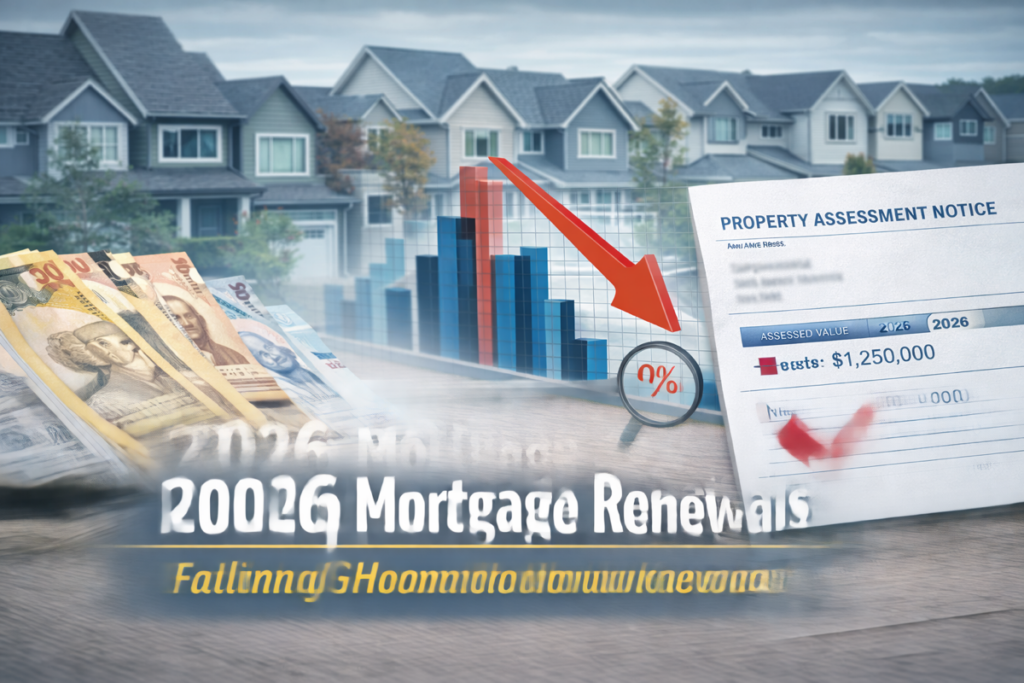
Powerful Guide: 2026 Mortgage Renewals Could Shock BC Homeowners – Here’s What to Do

Why 2026 Mortgage Renewals Are a Big Deal in BC

In 2021, thousands of BC homeowners secured record-low mortgage rates, often under two percent. As those five-year fixed terms come up for renewal in 2026, the situation has changed dramatically. Current interest rates are hovering between five and six percent, which could mean hundreds or even thousands of dollars more in monthly payments.

For example, a $600,000 mortgage at 1.89 percent would have had a monthly payment around $2,500. That same mortgage at six percent now costs roughly $3,900 each month. This increase is what financial experts are calling a mortgage renewal shock.

How Much Will Renewed Mortgages Cost in 2026

Fixed vs Variable Rate Renewals

If you had a fixed-rate mortgage, you may be facing your first increase in years. Variable-rate borrowers have already felt the impact of rate hikes over time. Renewals in 2026 will likely mean higher payments for both, although future rate drops could offer some relief for variable rates.

Real Examples in BC

A homeowner in Burnaby renewed their mortgage in January and saw payments rise from $3,000 to $4,100. In Kelowna, a couple extended their amortization period to reduce payments and avoid selling. These stories are becoming more common across the province.


Should You Be Worried About Your Renewal

While many lenders say the situation is manageable, that depends on your income, debt load, and financial flexibility. Some households will adapt easily, but others may struggle to meet new monthly costs.

Who Is Most at Risk


Mortgage Renewal Options You Should Know

Negotiate with Your Current Lender

Lenders often send out early renewal offers. Don’t accept the first rate. Ask for a better deal. Banks are more flexible than many people think.

Consider Switching Lenders

Another lender might offer a better rate, but switching comes with potential costs like appraisal and legal fees. You’ll also need to pass the current mortgage stress test again.

Look Into Refinancing

Even with high rates, refinancing could help reduce payments by extending your amortization or consolidating other debts into your mortgage.


What If You Can’t Afford Your New Mortgage Payment

Talk to Your Lender Early

Many lenders are offering help to homeowners. Options include temporary payment deferrals, interest-only payments, or extended amortization terms.

Sell Proactively If Needed

If no solution works and your payments are unmanageable, selling might be a better option than defaulting. Acting early protects your credit and your remaining equity.


BC Market Update for 2026

Sales activity has slowed across BC, especially in Metro Vancouver. Home prices have declined in many areas, with 2026 property assessments showing drops of five to ten percent. Interest rates remain high, but many experts expect them to slowly decline later this year or early next year.

This means there could be better conditions ahead for buyers, but current homeowners must adjust their finances now.


Tools to Help You Prepare


Frequently Asked Questions

Should I renew my mortgage early

Early renewal might help you avoid future rate hikes, but check for penalties and compare your options.

Can I extend my amortization period

Yes. Some lenders allow amortizations of 30 or even 40 years to lower your monthly payment. Keep in mind this means you’ll pay more interest over time.

Will I have to requalify if I switch lenders

Yes. You must pass the current mortgage stress test, which uses a higher qualifying rate than your actual contract rate.

Is it better to go fixed or variable in 2026

Shorter fixed terms like two or three years are popular right now. They give stability while offering flexibility if rates fall.

Can I be denied a renewal

Your current lender cannot deny your renewal unless you are in default. If switching lenders, yes, you must requalify.

What if I can’t make the new payment

Contact your lender as early as possible. Options exist to help you avoid default, and in some cases, it may be smarter to downsize or sell.


Conclusion: Plan Ahead to Avoid Payment Shock

The 2026 mortgage renewal cycle in BC is a wake-up call for homeowners. Higher interest rates are here, and many will face bigger payments. But with the right knowledge, planning, and expert support, you can stay ahead of the curve. Start your renewal strategy today and protect your financial future.

Explore Further: If your renewal is prompting you to rethink your housing strategy, presale can offer more flexibility than resale. See our North Vancouver presale condos for projects with phased deposit structures and extended closing timelines.

Why 2026 Might Be the Year to Buy a Condo in Vancouver: Data Says Yes

The Vancouver Condo Market Is Quietly Shifting

For years, buyers trying to buy a condo in Vancouver faced rising prices, intense competition, and little room for negotiation. That landscape has now changed. As we move into 2026, the data is pointing to a rare window where condo buyers finally have leverage.

Prices have softened, inventory has grown, and borrowing costs have started to ease. Together, these factors are creating conditions that many buyers have not seen in over a decade.

Condo Prices Have Pulled Back Across Metro Vancouver. As of December 2025, the benchmark price for an apartment in Metro Vancouver sits at approximately $710,000, reflecting a meaningful year over year decline. This correction is not limited to one area. It is widespread across the region.

Several areas experienced even larger adjustments:

• Maple Ridge saw prices fall close to eight percent

• Vancouver East declined by nearly six percent

• Richmond dropped over six percent

• West Vancouver experienced double digit percentage declines in some apartment segments

After years of rapid appreciation, this reset has made condos noticeably more attainable for first time buyers and long term investors.

Inventory Is Up and Competition Is Down

One of the most important shifts in the condo market is supply. Active listings increased significantly throughout 2025 while sales slowed.

In December alone, condo sales were well below the long term seasonal average. This has changed buyer behavior in meaningful ways.

Buyers now benefit from:

• More choice across buildings and floor plans

• Fewer multiple offer situations

• More time to review strata documents

• Greater negotiating power on price and terms

This slower pace allows buyers to make thoughtful decisions rather than rushed ones.

Interest Rates Are Starting to Work in Buyers’ Favor

Interest rates were the biggest obstacle for buyers in 2023 and 2024. That pressure began easing in late 2025 when borrowing costs dropped by nearly one full percentage point.

As we move through 2026, improved mortgage conditions could further increase affordability. Even small rate reductions can have a meaningful impact on monthly payments and overall purchasing power.

When combined with lower prices, this creates one of the strongest affordability environments condo buyers have seen in years.

Why Condos Make Sense for First Time Buyers in 2026

Condos continue to be the most accessible way to enter the Vancouver real estate market. In the current cycle, they offer additional advantages.

Key benefits include:

• Lower purchase prices compared to townhomes and detached homes

• Smaller down payment requirements

• Strong locations near transit, employment hubs, and amenities

• Easier maintenance and long term livability

With inventory elevated and competition reduced, first time buyers can secure well located units without overextending financially.

Best Areas to Buy a Condo Right Now

Not all markets behave the same. Based on recent pricing trends, inventory levels, and long term growth prospects, several areas stand out in early 2026.

AreaWhy It Stands Out
Vancouver EastImproved affordability with strong rental demand
RichmondPrice pullbacks paired with transit oriented growth
CoquitlamStrong value near SkyTrain and town centre hubs
Maple RidgeLowest entry pricing with long term upside
BurnabyStable demand and consistent pre sale launches

These areas offer a combination of value today and growth potential over time.

Pre Sale Condos Add Another Layer of Opportunity

For buyers considering pre sale condos, 2026 presents a particularly attractive setup.

Many developers are responding to market conditions by offering:

• Flexible deposit structures

• Incentives such as upgrades or credits

• Competitive pricing compared to recent years

Pre sales allow buyers to lock in today’s pricing while taking possession in one to three years, often after the broader market has stabilized.

Frequently Asked Questions

Will condo prices drop further in 2026?

Prices may soften slightly in the short term, but most indicators suggest stabilization as interest rates ease and buyer confidence returns.

Is resale or pre sale better right now?

Resale offers immediate occupancy and negotiation opportunities. Pre sale offers flexibility, time, and long term positioning. The right option depends on your timeline.

Are bidding wars common for condos now?

They are far less common than in previous years, especially in buildings with higher inventory.

What is the average condo price in Greater Vancouver?

The regional benchmark sits around $710,000, with many options available below that level in suburban markets.

Are condos still a good long term investment?

Well located condos near transit and employment centers continue to perform well over time, particularly when purchased during market resets.

Final Thoughts: Timing Matters and 2026 Is Different

The Vancouver condo market in 2026 looks very different than it did just a few years ago. Prices have adjusted, inventory is healthy, and financing conditions are improving.

For buyers who have been waiting for the right moment, this could be the most balanced entry point the market has offered in years.

Smart decisions, good locations, and long term thinking will matter more than ever.

Explore Further: If the data has convinced you 2026 is your year, start exploring your options. Browse our Downtown Vancouver presale condos to see what’s active and get on the VIP list before public release.

Compare